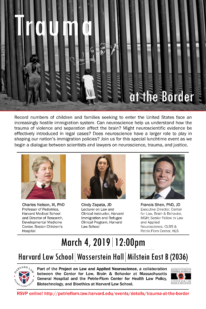
At the center of contemporary political debate are the record numbers of migrant families and children at the U.S.-Mexico border. As these parents and children flee the trauma of violence in their native countries, they are now experiencing the trauma of navigating an increasingly hostile immigration system. What can neuroscience tell us about the effects of these traumatic experiences on the brains of the children and adults? And how might the neuroscience of trauma and brain development affect legal cases? Can advances in mobile neuroimaging provide practitioners with real-time brain evidence of trauma? Does neuroscience have a larger role to play in shaping our nation’s immigration policies? This panel session brought together scientists and lawyers to start a dialogue on neuroscience, trauma, and justice.
Charles Nelson, III, PhD, Professor
of Pediatrics, Harvard Medical School and Director of Research,
Developmental Medicine Center, Boston Children’s Hospital
Cindy Zapata, JD,
Lecturer on Law and Clinical Instructor, Harvard Immigration and
Refugee Clinical Program, Harvard Law School; Leader of 2018 HLS student
trip to provide legal services to immigrant families separated in the
Karnes Detention Center in Texas
Moderator: Francis X. Shen, PhD, JD,
Executive Director, Harvard Center for Law, Brain &
Behavior, Massachusetts General Hospital and Senior Fellow in Law and
Applied Neuroscience, Petrie-Flom Center in Health Law Policy,
Biotechnology, and Bioethics, Harvard Law School; Associate Professor of
Law and McKnight Land-Grant Professor, University of Minnesota Law
School
Part of the Project on Law and Applied Neuroscience,
a collaboration between the Center for Law, Brain & Behavior at
Massachusetts General Hospital and the Petrie-Flom Center for Health Law
Policy, Biotechnology, and Bioethics at Harvard Law School.